Under Armour's Pricing Strategy: How Kevin Plank Is Killing SKUs to Go Premium Against Nike and Lululemon
We mapped Under Armour's product catalog against Nike, Lululemon, Gymshark, and Adidas — category breakdowns, discount patterns, and the $5B brand's deliberate pivot from value to premium.
First: Why Should You Care About Pricing Intelligence?
Under Armour is executing one of the boldest pricing pivots in athletic apparel — in real time
Under Armour is the rare case of a $5 billion brand deliberately shrinking itself to grow profitability. CEO Kevin Plank returned in 2024 with a simple thesis: sell fewer products at higher prices. The result? Revenue dropped 9% in FY2025, but gross margin climbed 180 basis points to 47.9%. That trade-off — volume for margin — is one of the hardest calls in DTC, and Under Armour is making it at scale. Here's why that matters for your brand:
Under Armour generated $5.164 billion in FY2025 revenue — down 9% year-over-year, but intentionally so. The brand is cutting the "good" product tier entirely, focusing on "better" and "best" products with higher margins. Apparel ($3.45B) and footwear ($1.2B) are both being repositioned upmarket.
Under Armour cut 25% of its SKUs over 18 months — eliminating entire product tiers to sharpen positioning. CEO Kevin Plank's mantra is "sell more of less at higher full price." They raised the Tech t-shirt to $25, launched a $45 StealthForm hat, and introduced backpacks priced $80–$100 above typical category products.
Gross margin improved to 47.9% in FY2025 despite revenue declines — proving the premium strategy is working on the unit economics side. For context, Nike's gross margin is ~45% and Lululemon's is ~58%. Under Armour is closing the gap with premium competitors while still maintaining accessible entry prices through their Fastly-powered infrastructure.
Under Armour
Nike
Lululemon
Gymshark
Price Range Analysis
How Under Armour spans $20 tees to $160 performance shoes — and why the middle is getting cut
Under Armour's pricing spans a wide range, but the sweet spot is narrowing by design. Apparel clusters between $20 and $80, with the iconic UA Tech 2.0 tee anchoring the entry point at $20 and the Flex Fleece Hoodie marking the top at $80. Footwear runs $20 (slides) to $160 (Velociti Distance). The deliberate elimination of low-margin "good" tier products means fewer products under $30 and more emphasis on the $40–$80 performance range.
Compare that to Nike, where performance lines start at $25 but quickly climb past $120, or Lululemon, where the entry point for leggings is $88. Under Armour occupies a middle ground — cheaper than Nike's premium tiers but more expensive than Gymshark's $26–$68 range. The turnaround strategy is pushing UA closer to Nike territory by cutting low-end SKUs and investing in premium products.
We estimate based on underarmour.com product page sampling, March 2026. Percentages represent approximate share of total SKUs in each price band.
Under Armour's "sell more of less" strategy is visible in the catalog. The brand cut 25% of SKUs and reduced materials by 30%, per CEO Kevin Plank. The remaining products skew toward the $40–$80 performance range — the zone where margins are highest and brand perception is strongest. Entry-level products under $25 are being kept strategically as gateway products, not volume plays.
This is exactly the kind of pricing intelligence LeadMaxxing generates automatically. Our AI scrapes competitor catalogs, maps price bands, and flags when competitors adjust strategy — see how it works →
Category Breakdown
Training tops, compression gear, shorts, hoodies, and footwear mapped by price
Compression and performance training gear is the hero category. HeatGear Elite compression tops at $50–$55 represent Under Armour's core brand DNA — the technology-driven performance apparel that Kevin Plank originally founded the company to build. This category commands the highest price points in apparel and carries the strongest brand equity.
| Category | Price Range | Core Price | Top Seller Example |
|---|---|---|---|
| Training Tees | $20 – $50 | $25 | UA Tech 2.0 Short Sleeve |
| Compression Tops | $50 – $55 | $50 | HeatGear Elite Compression SS |
| Shorts | $40 – $50 | $50 | UA Vanish Woven 2.0 6" |
| Sports Bras | $25 – $50 | $35 | UA Infinity High Sports Bra |
| Hoodies | $50 – $80 | $80 | UA Flex Fleece Hoodie |
| Running Shoes | $75 – $160 | $100–$130 | UA Velociti Pace / Curry 13 |
The UA Tech 2.0 is the gateway product. At $20, it's the cheapest branded training tee from any major performance brand. A customer buys the Tech 2.0, likes the fit, then upgrades to $50 HeatGear compression gear. Kevin Plank raised this tee to $25 as part of the premium push — still accessible, but signaling the brand won't race to the bottom.
Notice how footwear prices reach well above apparel. The Curry 13 at $140 and UA Velociti Distance at $160 position Under Armour competitively against Nike's performance running line ($130–$180) while the brand's advertising strategy increasingly showcases these premium products.
A full Under Armour training outfit (shorts + compression top + tech tee) costs $110–$130. That's comparable to a single pair of Lululemon Align leggings ($98–$128). Under Armour's value proposition is clear: performance-level gear at accessible prices — but the gap is closing as the brand cuts low-end products.
Most DTC brands guess at category pricing. LeadMaxxing tracks your competitors' catalogs daily, flagging new products, price changes, and category shifts before you notice them manually — start free →
Competitor Price Mapping
Under Armour vs Nike, Lululemon, Gymshark, and Adidas across every category
Under Armour sits in the mid-premium zone — cheaper than Nike and Lululemon, more expensive than Gymshark. They undercut Lululemon by 30–50% on comparable categories, sit 10–20% below Nike on performance gear, and price above Gymshark by roughly 20–40%. Against Adidas, UA competes head-to-head on most categories.
| Category | Under Armour | Nike | Lululemon | Gymshark | Adidas |
|---|---|---|---|---|---|
| Training Tops | $20–$55 | $25–$65 | $48–$78 | $28–$44 | $25–$55 |
| Sports Bras | $25–$50 | $30–$55 | $48–$68 | $26–$44 | $30–$45 |
| Shorts | $40–$50 | $45–$65 | $58–$88 | $30–$48 | $35–$55 |
| Hoodies | $50–$80 | $55–$120 | $98–$128 | $42–$50 | $55–$90 |
| Full Outfit* | $100–$180 | $120–$250 | $200–$320 | $90–$130 | $110–$200 |
*Full outfit = top + shorts/leggings + sports bra. Source: Product page scrapes of underarmour.com, nike.com, lululemon.com, gymshark.com, adidas.com. March 2026.
The Nike gap is Under Armour's biggest strategic challenge. Nike's performance lines start close to UA's prices ($25 vs $20 for basic tees) but the brand commands a significant premium at the high end. UA's entire apparel range tops out around $80, while Nike routinely sells hoodies and jackets at $120+. Kevin Plank's strategy is to close this perception gap without the heritage advantage Nike holds.
Gymshark is the disruptor from below. With 100% DTC distribution, Gymshark undercuts Under Armour on most categories while maintaining strong margins. A full Gymshark outfit costs $90–$130 vs UA's $100–$180. UA's wholesale-heavy model (roughly 60% of revenue) means they compete against their own products at markdown prices in department stores — something Gymshark's DTC-only model avoids entirely.
Track Competitor Pricing Automatically
LeadMaxxing monitors competitor product pages, detects price changes, and alerts you when competitors adjust their strategy. The same intelligence shown above — updated daily, for your brand.
Start free →Discount Strategy
Semi-Annual Sales, outlet channels, and the deliberate pull-back from promotions
Under Armour's discount strategy is being overhauled as part of the turnaround. Historically, the brand was known for aggressive promotions and deep discounting through outlets and wholesale partners. Kevin Plank's return brought a deliberate pull-back: fewer promotions, less outlet inventory, and a focus on protecting full-price sales. The goal is to retrain consumers to buy at full price.
Semi-Annual Sale
Black Friday
Student Discount
Outlet Channel
Annual Discount Calendar
Under Armour is deliberately reducing promotional activity to protect brand perception. The company budgeted $70–$90 million in restructuring charges to support this transition. Full-price months have increased from roughly 6 to 8 per year as the brand pulls back from mid-season flash sales and outlet-driven clearance. Their email and CRM strategy is shifting from discount-driven messaging to product storytelling and performance narratives.
The UA Rewards Program
Under Armour's loyalty program replaces discounts with perks. UA Rewards is a free points-based program offering early access to new releases, birthday double points, and exclusive member events. The strategy mirrors the broader shift: instead of training customers to wait for sales, reward them for buying at full price. This approach is similar to how Nike's SNKRS app drives full-price purchases through exclusivity.
Market Positioning
How Under Armour is moving from value-adjacent to premium performance — and why it's risky
Under Armour is executing the hardest move in brand strategy: moving upmarket without losing your base. They're not trying to be Lululemon (yoga-lifestyle) or Gymshark (community-first DTC). They're doubling down on performance — team sports, training, and competition — and pricing accordingly. The question is whether consumers will follow.
Source: Product page scrapes of underarmour.com, nike.com, lululemon.com, gymshark.com, adidas.com. March 2026. Full outfit = top + shorts/leggings + sports bra.
The Positioning Playbook
Revenue (FY25)
Distribution
Founded
Market Cap
Under Armour's brand repositioning rests on four pillars:
- Performance DNA: The original compression technology — HeatGear, ColdGear, and Storm product lines — remains the core differentiator against lifestyle-first competitors like Lululemon and Gymshark
- Team Sports Heritage: Deep roots in American football, baseball, and basketball through partnerships like the Curry brand — a distribution channel that lifestyle brands cannot replicate
- Premium Fewer: "Sell more of less" — reducing SKUs by 25%, cutting materials by 30%, and investing in higher-quality "better" and "best" tier products
- Global Expansion: EMEA revenue held flat ($1.1B) while North America declined 11% — international markets are the growth engine while the home market is restructured
Under Armour's bet is that margin expansion beats revenue growth. By cutting 25% of SKUs, reducing promotions, and raising prices on core products, they're trading short-term volume for long-term brand health. Gross margin improved 180 basis points in FY2025 despite a 9% revenue decline. The tracking and analytics infrastructure behind this strategy helps them measure which products justify premium pricing.
Key Findings
- → Under Armour generated $5.164 billion in FY2025 revenue (verified fact, SEC filing) with gross margin improving to 47.9% despite intentional 9% revenue decline under Kevin Plank's turnaround strategy
- → The brand cut 25% of SKUs over 18 months (verified fact, SGB Online) — eliminating the "good" product tier to focus on "better" and "best," while raising the Tech t-shirt to $25 and launching premium accessories like the $45 StealthForm hat
- → Under Armour undercuts Lululemon by 30–50% across comparable categories: training tops $20–$55 vs $48–$78, hoodies $50–$80 vs $98–$128, with a full outfit costing $100–$180 vs $200–$320
- → We estimate the $25–$80 apparel range captures the majority of Under Armour's catalog, with the brand deliberately reducing sub-$25 products and investing in the $40–$80 performance zone where margins are highest
- → Wholesale accounts for roughly 60% of revenue — unlike 100% DTC competitors like Gymshark — creating both distribution scale and brand-dilution risk through department store markdowns that the premium strategy aims to correct
What This Data Means for You
Turning Under Armour's pricing pivot into your competitive advantage
If you're a DTC brand, Under Armour's pricing story is a masterclass in repositioning under pressure. Their willingness to sacrifice $500M+ in annual revenue to improve margins is the kind of strategic discipline most brands talk about but never execute. The data above shows exactly where Under Armour sits relative to competitors, and the patterns below show how to apply those lessons. Whether you're considering your own content and SEO strategy or rethinking social media positioning, pricing touches everything.
LeadMaxxing Automates Competitor Price Monitoring
The pricing intelligence in this report took weeks to compile manually. LeadMaxxing scrapes competitor product pages, maps price bands, flags price changes, and benchmarks your positioning — updated weekly for your brand. Plans start at $29/month.
Try competitor price tracking →5 Things You Can Implement Today
Actionable lessons from Under Armour's pricing playbook
Cut SKUs to sharpen positioning
Under Armour's 25% SKU reduction improved margins 180 basis points. Audit your catalog for low-margin products that dilute your brand perception. LeadMaxxing tracks how competitors manage catalog size and identifies products worth cutting.
Reduce discounting, invest in loyalty
Under Armour is replacing mid-season sales with a rewards program that incentivizes full-price purchases. Shift from discount-driven to perk-driven retention. LeadMaxxing monitors competitor promotional calendars so you know when not to discount.
Price your gateway products strategically
The $20 UA Tech tee is a calculated entry point — cheap enough to acquire customers, premium enough to signal quality. Build a price ladder from gateway to hero products. LeadMaxxing maps your competitors' price ladders automatically.
Use owned retail as a testing ground
Under Armour uses DTC stores as "proving grounds" before scaling to wholesale. Test premium pricing in channels you control before rolling out broadly. LeadMaxxing helps track conversion by channel and price point.
Supercharge Your Leads with LeadMaxxing
Get a free LeadMaxxing account and start supercharging your leads. Start free →
Request a FREE Demo + Report
For Your Brand
Request a demo and we'll generate a full competitive analysis for YOUR brand. The same intelligence you just read — comparison with competitors, actionable strategies, and AI-powered recommendations.
More Under Armour Intelligence
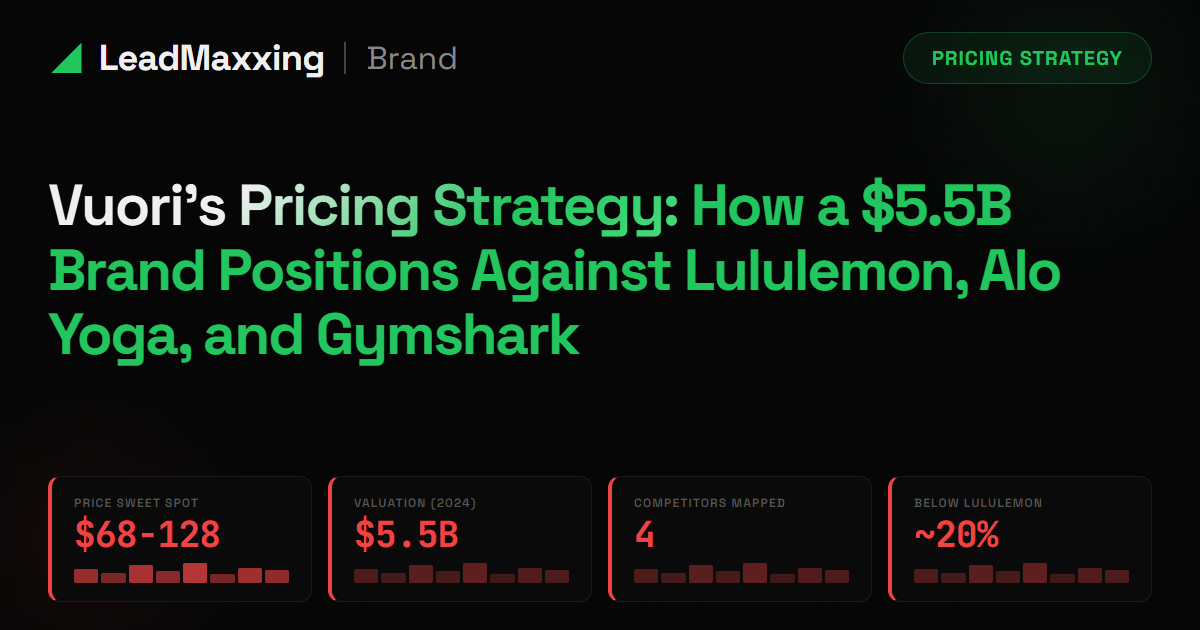
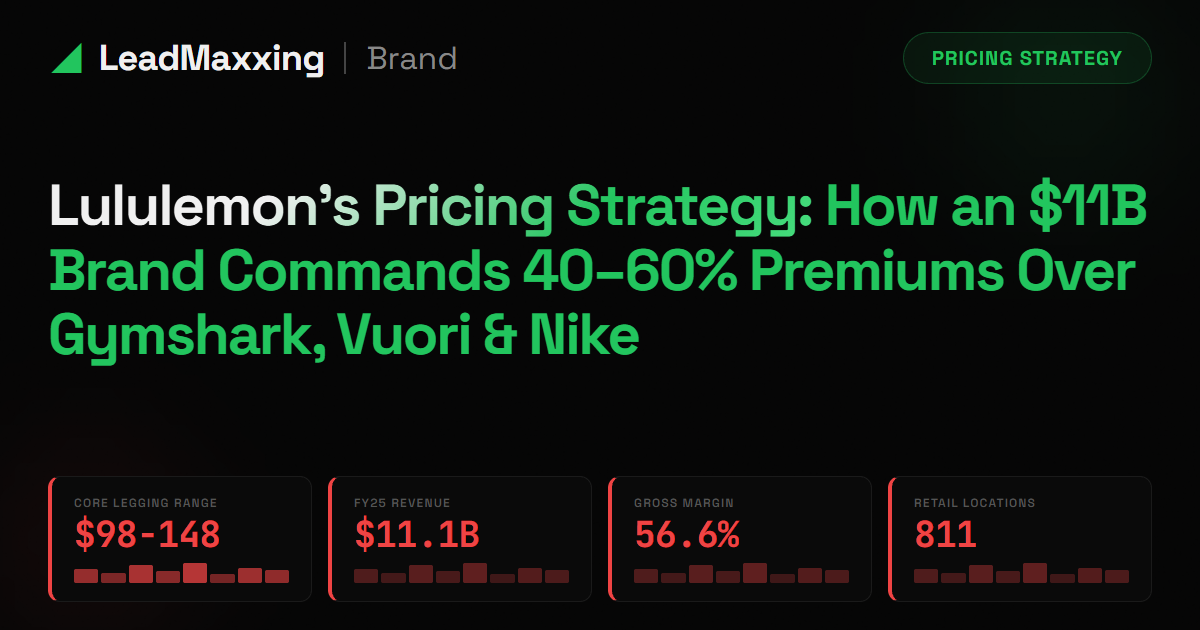
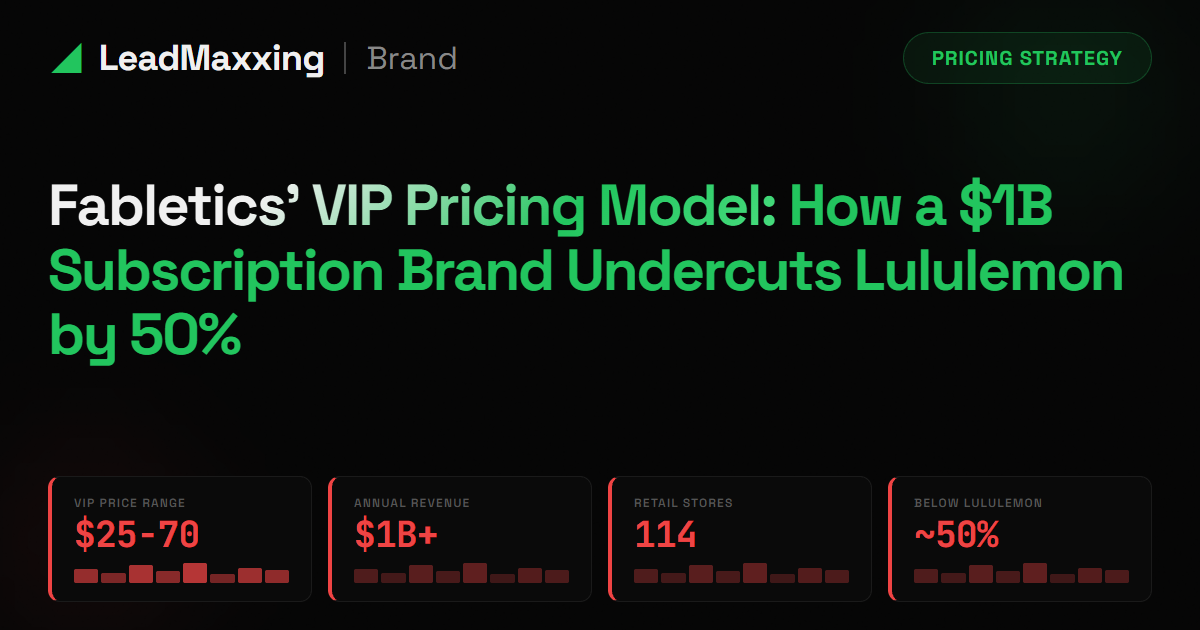
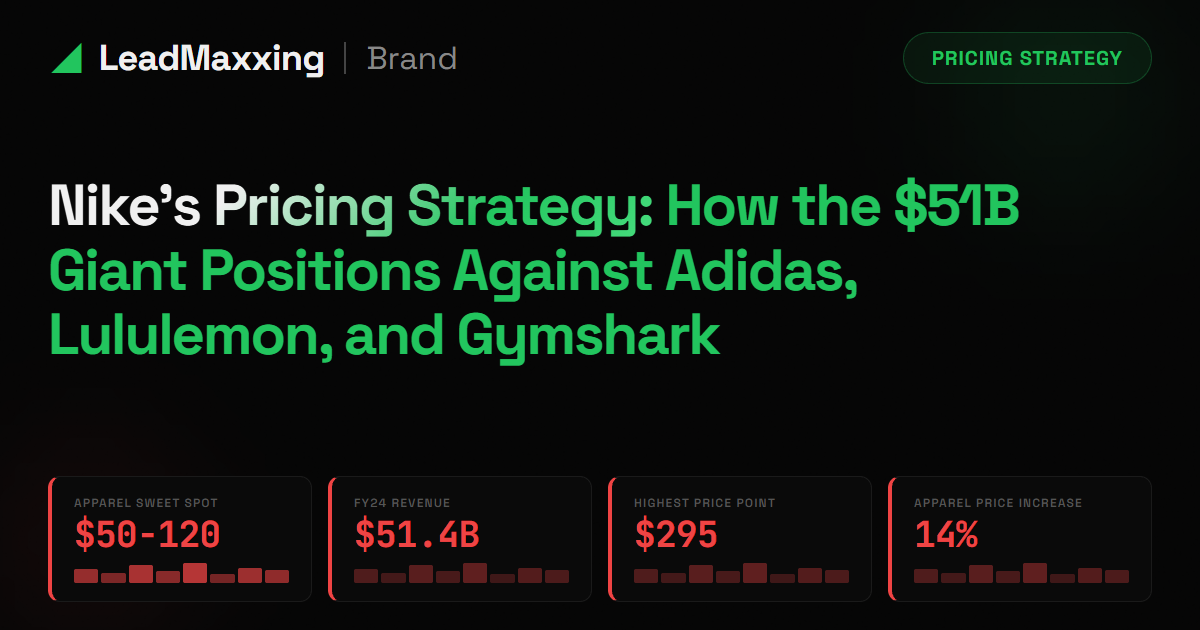
Pricing & Positioning for Similar Brands
Frequently Asked Questions
How much does Under Armour apparel cost?
Is Under Armour cheaper than Nike?
What is Under Armour's pricing strategy under Kevin Plank?
Does Under Armour run sales or discounts?
How does Under Armour compare to Lululemon on price?
What is Under Armour's annual revenue?
How is Under Armour repositioning its brand?
How does Under Armour's pricing compare to Gymshark and Adidas?
Sources & References
prnewswire.com
prnewswire.com
sgbonline.com
retaildive.com
wwd.com
thekrazycouponlady.com
underarmour.com
nike.com · lululemon.com · gymshark.com