Inside the Tech Stack Powering Under Armour's $5.2B Revenue — SFCC, Fastly, Algolia & More
We mapped Under Armour's entire marketing and infrastructure stack through DNS records, HTTP headers, and technology fingerprinting — revealing a headless Salesforce Commerce Cloud frontend, Fastly CDN, and a security header score that trails the competition.
First: Why Should You Care About Another Brand's Tech Stack?
Hard data on what a $5.2B athletic brand actually runs under the hood — and what it means for your stack
Because reverse-engineering what winning brands build on is the highest-ROI competitive research you can do. Under Armour is a publicly traded, $5.2B revenue athletic brand (SEC filing, FY2025) that recently overhauled its entire digital infrastructure. Their choices reveal exactly which platform bets matter at enterprise scale.
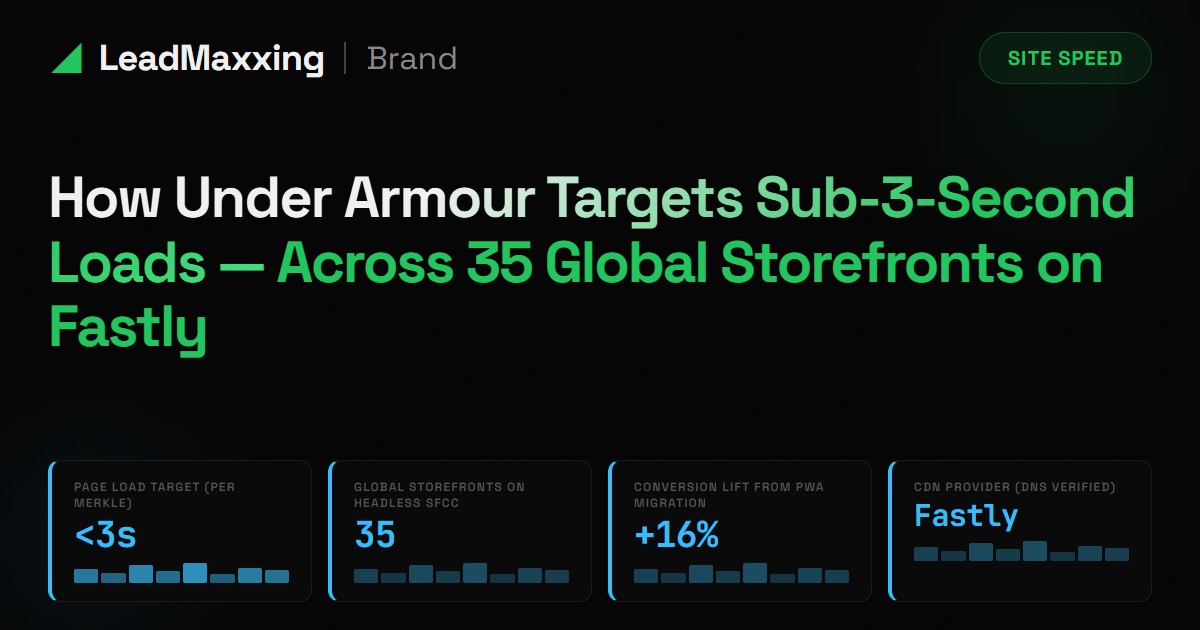
Under Armour runs 35 global storefronts on a single headless Salesforce Commerce Cloud instance. — Their 2023 headless migration, documented in Merkle's published case study, delivered a 10% improvement in mobile conversion and sub-three-second page loads. This is what enterprise ecommerce architecture looks like when done right.
Algolia search drove a 35% higher conversion rate for Under Armour customers who used site search — compared to those who browsed without it. This is a real, published case study result, not an estimate. When you know which search tool a competitor uses and what results they got, you can make the same investment with confidence.
Under Armour scores just 1 out of 6 on security headers — a grade F. Only HSTS is present. No Content-Security-Policy, no X-Frame-Options, no Referrer-Policy, no Permissions-Policy. For a $5.2B public company, this is a significant gap. Monitoring competitor security headers reveals engineering priorities and potential vulnerabilities — intelligence that press releases and ad libraries cannot provide.
How We Got This Data
Technology fingerprints reveal everything.
Unlike brands with verbose CSP headers (which act as a public inventory of tools), Under Armour's headers are minimal. So we used a combination of DNS record analysis, HTTP header inspection, and technology detection tools like BuiltWith and SecurityHeaders.com to reconstruct their stack.
We also cross-referenced findings with published vendor case studies — Merkle, Algolia, and AWS all have public documentation confirming their partnerships with Under Armour. This gives us higher confidence than header analysis alone.
All data comes from publicly accessible HTTP response headers, DNS records, and technology detection tools. No private data, no account access, no proprietary code. Just reading what the server tells every browser on every page load.
This is exactly the kind of analysis LeadMaxxing runs automatically on any brand you point it at — tech detection, DNS recon, security audit, cost estimates — all in under 60 seconds.
Tool Breakdown by Category
13 key tools across four major categories.
The Headless SFCC Architecture
Enterprise commerce powering a $5.2B brand across 35 global storefronts.
Under Armour doesn't run a standard Salesforce storefront. In 2023, they migrated to a headless architecture — decoupling the frontend experience from the SFCC commerce engine:
This headless pattern lets Under Armour control every pixel of the storefront experience — page speed, personalization, layout testing — while SFCC handles the commerce logic: inventory, pricing, cart, checkout. The result: sub-three-second page loads across 35 storefronts, per Merkle's published case study.
Going headless gave Under Armour complete control over frontend performance independent of Salesforce's rendering engine. This enabled the 10% mobile conversion improvement and supports their rapid homepage iteration. It also positions them to adopt emerging frontend frameworks without re-platforming commerce.
Want This Analysis for Your Brand?
LeadMaxxing runs the same tech detection, DNS recon, and security audit automatically. Get your full report in 60 seconds when you create a free account.
Get Your Free Tech Stack Report → Free account — no credit card requiredThe Full Tech Stack
Every tool we identified, organized by category with pricing benchmarks.
Advertising Platforms (4 tools)
Under Armour runs paid advertising across major platforms. Technology fingerprinting reveals scripts from these providers:
Analytics & Optimization (3 tools)
Under Armour's analytics stack combines Google's free tier with enterprise-grade search optimization:
Algolia enterprise search alone likely costs Under Armour $20K-$50K per year (we estimate, based on published pricing tiers). The 35% conversion lift documented in their case study makes this one of the highest-ROI tools in their stack.
LeadMaxxing vs Under Armour's Analytics Stack
Under Armour uses GA4 + GTM + Algolia for analytics and search optimization. LeadMaxxing's tracking script captures every visitor interaction — page views, scroll depth, form submissions, click IDs — building behavioral profiles automatically. Our AI generates personalized landing pages and runs A/B tests without the enterprise price tag. Not the same scale as Algolia, but 80% of the growth playbook for $29/month.
See how it works →Customer Engagement (2 tools)
Infrastructure & Operations (4 tools)
n.sni.global.fastly.net. Edge delivery for all 35 storefronts — a key factor in their sub-three-second page loads. We estimate ~$50K-$200K/year at Under Armour's traffic volume.Security Headers: Grade F (1/6)
Only one of six recommended security headers is present — a significant gap for a public company.
Under Armour implements only 1 of 6 standard security headers. Verify at securityheaders.com.
max-age=63072000 — forces HTTPS for ~2 years. Present but missing includeSubDomains and HSTS preload directives.nosniff, browsers may MIME-sniff responses, potentially executing uploaded files as scripts.A $5.2B public company scoring 1/6 on security headers signals that security hardening is not currently a priority for their web team. The missing CSP header is especially notable — it both weakens security and prevents the kind of tool-inventory analysis that competitors can do against brands with verbose CSPs. Ironically, having no CSP makes the stack harder to map but the site more vulnerable.
Curious how your own security headers stack up? LeadMaxxing's free report includes a full header audit with your score, missing headers, and fix-it instructions — no engineering background required.
The Cost Reality
What does a stack like this actually cost?
These are estimates based on publicly listed pricing tiers. Actual costs depend on contract terms, volume discounts, and custom enterprise agreements.
This doesn't include significant ad spend across multiple platforms, engineering salaries for the headless frontend, or Merkle's implementation services. Total marketing technology investment: well into seven figures annually.
Automate the entire playbook with LeadMaxxing
LeadMaxxing scrapes competitor pages, generates landing pages from their styles, tracks every visitor interaction, runs autonomous A/B tests, and automates email campaigns from just $29. Or start with a free account today and get this analysis for your own brand as a free bonus.
Get Free Report + Account →How Under Armour Compares to Industry Benchmarks
Where they rank across key operational metrics.
Security: Below Average
Under Armour scores 1/6 on security headers — a grade F. Most enterprise ecommerce sites score at least 2-3 out of 6.
Platform: Enterprise Grade
Salesforce Commerce Cloud with headless architecture places Under Armour in the top tier of ecommerce platform sophistication alongside brands like Puma and Adidas.
Search: Best-in-Class
Algolia is considered the gold standard in ecommerce search. With a 35% conversion lift, Under Armour's search investment is one of their strongest competitive advantages.
Global Reach: Exceptional
35 storefronts across 3 regions on a single SFCC instance is among the broadest global footprints in athletic apparel ecommerce.
Source: Compiled from Merkle case study, Algolia case study, SecurityHeaders.com scan, and BuiltWith technology profiling (2026).
See how your brand compares
LeadMaxxing benchmarks your tech stack, security headers, and ad coverage against 100+ DTC brands automatically. Find out if you're top 3% or bottom 50% — and what to fix first.
Create a free account to benchmark your data →What Even Under Armour Could Improve
No brand is perfect. Here are the gaps.
Security headers are critically weak
1/6 headers and a grade F is unacceptable for a public company processing millions of transactions. Adding CSP, X-Frame-Options, X-Content-Type-Options, Referrer-Policy, and Permissions-Policy is a straightforward fix.
No visible Content-Security-Policy
Without CSP, the browser allows scripts from any domain — the single most impactful security header for preventing XSS attacks and controlling third-party script execution is absent.
HSTS configuration could be stronger
HSTS is present but with max-age only. Adding includeSubDomains and preload directives would ensure all subdomains use HTTPS and qualify for browser HSTS preload lists.
No visible CDP or advanced personalization
Unlike some competitors who run dedicated Customer Data Platforms, Under Armour's detectable stack lacks a visible CDP. At $5.2B revenue, enterprise personalization tools would likely deliver significant ROI.
Most of these gaps — security headers, missing personalization, limited analytics — can be addressed incrementally. LeadMaxxing takes a different approach: one lightweight script that handles visitor ID, tracking, personalization, and email — no enterprise complexity required.
Key Findings
- → Under Armour runs on Salesforce Commerce Cloud with a headless frontend, powering 35 global storefronts across 3 regions — implemented by Merkle (dentsu) with a 10% mobile conversion improvement documented in their published case study.
- → Under Armour scores 1 out of 6 on security headers (grade F), with only HSTS present. Missing CSP, X-Frame-Options, X-Content-Type-Options, Referrer-Policy, and Permissions-Policy — significantly below the enterprise ecommerce average of 2-3.
- → Algolia site search delivers a 35% higher conversion rate for Under Armour shoppers who use search, per Algolia's published customer case study — making it one of the highest-ROI tools in their stack at an estimated $20K-$50K/year.
- → DNS records confirm Fastly CDN (CNAME: n.sni.global.fastly.net) as Under Armour's edge delivery network, enabling sub-three-second page loads at $5.2B revenue scale.
- → We estimate Under Armour's core SaaS infrastructure costs $500K-$1M+ per year — dominated by Salesforce Commerce Cloud ($200K-$500K), AWS for SAP ($100K-$500K), and Fastly CDN ($50K-$200K), based on publicly listed pricing tiers.
What This Data Means for You
Turning Under Armour's tech stack into your competitive advantage
Understanding exactly which tools a $5.2B brand runs — and where they have gaps — lets you make smarter technology decisions. Under Armour's headless SFCC architecture is aspirational, but their security header score shows that even enterprise brands have blind spots. You can learn from their wins (Algolia's 35% search conversion lift, Fastly's edge delivery) while avoiding their gaps (weak security headers, lack of visible personalization). Cross-reference with their pricing strategy and SEO approach to build the full competitive picture.
5 Things You Can Implement Today
Actionable lessons from Under Armour's tech stack playbook
Check your own security headers right now
Paste your domain into securityheaders.com. If you score higher than Under Armour's 1/6, you're already ahead of a $5.2B brand. If not, fixing it takes 30 minutes of server config. LeadMaxxing's free report includes a full header audit with your score and fix-it instructions.
Invest in site search before personalization
Algolia gave Under Armour a 35% conversion lift from search users alone. If you're spending on personalization but your site search is basic, flip the priority. LeadMaxxing tracks which search terms visitors use and generates optimized landing pages for high-intent queries automatically.
Benchmark your tech stack against competitors
Under Armour uses SFCC + Fastly + Algolia — but most brands under $50M can achieve similar results with simpler tools. LeadMaxxing's free report scans any competitor's DNS and headers to tell you exactly what they use.
Consider headless architecture for conversion gains
Under Armour's 10% mobile conversion improvement from going headless shows the ROI is real at scale. If you're on Shopify, Shopify Hydrogen offers a similar headless approach. LeadMaxxing works with any frontend — one script, no architecture changes needed.
Supercharge Your Leads with LeadMaxxing
Get a free LeadMaxxing account and start supercharging your leads. Start free →
Request a FREE Demo + Report
For Your Brand
Request a demo and we'll generate a full competitive analysis for YOUR brand. The same intelligence you just read — comparison with competitors, actionable strategies, and AI-powered recommendations.
More Under Armour Intelligence
Tech Stack Audits for Similar Brands
Sources & References
merkle.com
algolia.com
businesswire.com
securityheaders.com
builtwith.com
about.underarmour.com
Frequently Asked Questions
What ecommerce platform does Under Armour use?
What CDN does Under Armour use?
n.sni.global.fastly.net, routing through Fastly's global edge network. At Under Armour's traffic volume ($5.2B annual revenue), Fastly CDN costs are estimated at $50K–$200K per year depending on bandwidth and edge compute usage.What search technology powers underarmour.com?
What is Under Armour's website security header grade?
max-age=63072000. Missing headers include Content-Security-Policy, X-Frame-Options, X-Content-Type-Options, Referrer-Policy, and Permissions-Policy. This is below average for enterprise ecommerce. Verify at securityheaders.com.