How Gymshark Runs Ads on 6 Platforms Simultaneously — With Real ROAS Data
Cross-channel performance data, creative analysis, and the AI-powered budget system behind Gymshark's 6-platform ad machine.
First: Why Should You Care About Gymshark's Ad Strategy?
ROAS benchmarks, platform spend data, and creative performance from a brand spending millions
Because Gymshark is one of the few DTC brands transparent enough to reverse-engineer. Their ad library is public, their pixels are detectable, and their results speak for themselves:
Gymshark runs paid ads on 6 platforms simultaneously — Meta, Google, TikTok, Pinterest, Snapchat, and YouTube. Most DTC brands struggle with two. Their multi-platform approach reduces dependency on any single algorithm.
One "hidden" platform drove +227% revenue growth for Gymshark. While most brands fight over Meta CPMs, Gymshark found an underpriced channel that their competitors weren't even testing.
Raw UGC outperforms studio-shot creative by 3.2x on ROAS. Gymshark's best-performing ads look like they were filmed on a phone in a gym. The production budget paradox: spending less on creative produces more revenue.
The 6-Platform Ad Machine
How Gymshark coordinates paid ads across every major channel
Gymshark doesn't put all their ad budget into Meta and call it a day. They run paid advertising across six platforms simultaneously — each with dedicated creative, tailored targeting, and platform-specific performance goals. We confirmed all six via CSP header pixel detection on gymshark.com and cross-referenced with public ad library data. With £607M in FY24 revenue (FashionUnited), Gymshark is investing heavily across every major paid channel.
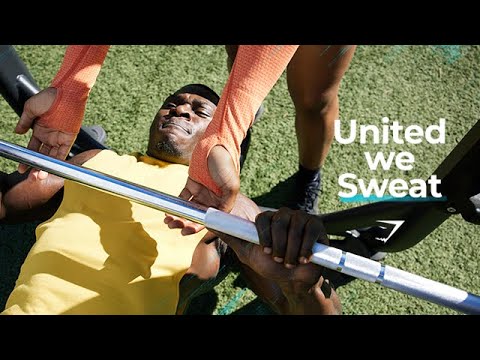
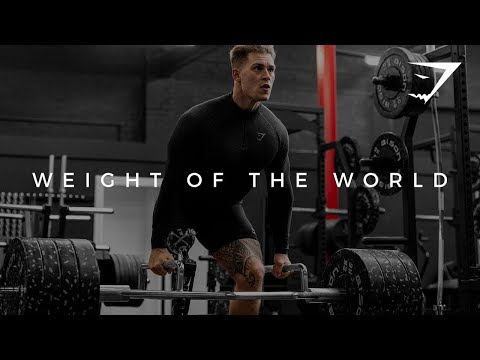
Gymshark's three flagship campaigns — each runs as paid creative across all 6 platforms. Click to watch on YouTube.
See Their Actual Ads
Click any platform to jump to real ad examples, embeds, and creative breakdowns:
Gymshark's Content-Security-Policy header allows scripts from Google (gtag, doubleclick), Meta (connect.facebook.net), TikTok (analytics.tiktok.com), Pinterest (pinimg.com), Snapchat (sc-static.net), and LinkedIn (snap.licdn.com). Additionally, mParticle serves as their central customer data platform, distributing tracking events to all six ad platforms server-side. See our Tech Stack report for the full CSP breakdown.
The Budget Allocation System
What makes Gymshark's multi-platform approach unusual isn't that they run on 6 platforms — it's how they allocate budget between them. Instead of manually shifting spend weekly, Gymshark uses an AI-powered closed-loop system:
Fospha measures true revenue impact across all platforms (not relying on each platform's self-reported metrics). Smartly's Predictive Budget Allocation ingests this data via a server-to-server integration and automatically reallocates spend to wherever it drives the greatest incremental revenue — in real time, without manual intervention.
Within days of activating this system, Gymshark was pushing actual revenue data into budget decisions rather than optimizing for in-platform proxy metrics (like ROAS reported by Meta, which famously over-attributes). The result: a 13% cross-channel ROAS uplift across all four paid social platforms.
This is exactly the kind of cross-platform attribution LeadMaxxing runs automatically — tracking every click and conversion across platforms so you know where to put your next dollar.
Platform-by-Platform Breakdown
Performance data and strategy for each ad channel
Each platform serves a different role in Gymshark's funnel. Here's what the data reveals about each one:
YouTube & Pre-Roll Ads
Gymshark's YouTube strategy spans brand campaigns, athlete profiles, and pre-rolls targeting fitness audiences. Here are verified Gymshark campaign videos — a mix of official channel uploads and production crew portfolios:
Browse all Gymshark Google/YouTube ads in the Transparency Center →
TikTok Ads & Spark Ads
TikTok is Gymshark's fastest-growing channel (+98% US revenue). They use Spark Ads to boost organic creator content and run platform-native humor:
Browse all Gymshark TikTok ads in the TikTok Ad Library →
Meta Ads (Facebook + Instagram)
Meta is Gymshark's largest single ad platform. With 1,000+ active ads in the Meta Ad Library, they run UGC athlete content, Dynamic Product Ads, and retargeting across Facebook and Instagram:
1,000+ Active Meta Ads
Gymshark runs the largest ad volume on Meta of any platform. Their creative mix includes UGC athlete content, Dynamic Product Ads with personalized product combinations, retargeting for cart abandoners, and localized campaigns per market (US, UK, Australia, Germany). On January 2, 2025 alone, they launched 135 new ads — scaling to 340 within 48 hours (Foreplay analysis).
Key insight: They A/B test ad copy, headlines, and CTAs continuously. The carousel format — showing leggings in multiple colors with each slide linking to its own product page — is a high-performing format for driving AOV.
f Browse all active ads in Meta Ad Library →Founder-Led Content (LinkedIn + YouTube)
Platform Performance Comparison
| Platform | Primary Role | Key Metric | Creative Style | Audience |
|---|---|---|---|---|
| Meta | Retargeting + scale | -13% CAC YoY | UGC + athlete content | 18-35, fitness enthusiasts |
| TikTok | Gen Z acquisition | +98% US revenue | Raw, unpolished, humor | 16-28, gym culture |
| Discovery + inspiration | +227% revenue | Outfit boards, recipes | 25-40, aspirational fitness | |
| Snapchat | Story-based conversion | +58% ROAS vs target | 6-card educational stories | 18-45 women, US/UK/CA |
| Intent capture | 356K keywords | Search + Shopping + YouTube | High-intent shoppers | |
| B2B + employer brand | 2K+ avg engagement | Founder-led, BTS content | Professionals, partners |
Run Ads Like Gymshark — Without the Agency
Gymshark tests 135 ad creatives in a single day with a full creative team. LeadMaxxing generates landing page variants from your existing pages, runs autonomous A/B tests, and auto-applies winners at 95% significance. The same test-and-scale philosophy, automated for $29/month.
Try autonomous A/B testing →Creative Analysis: What Their Ads Actually Look Like
UGC vs studio, format breakdowns, and real creative examples
Gymshark's creative strategy can be summarized in one sentence: authentic beats polished. Their Blackout campaign showed UGC-style ads filmed by athletes significantly outperformed studio-shot content on ROAS. That insight now drives creative across every platform — and their volume-first testing approach proves it works at scale.
The Creative Testing Machine
Gymshark treats ad creative like a volume game. On January 2, 2025, they launched 135 ads in a single day. Within 48 hours, that number grew to 340 ads worldwide. The strategy: flood platforms with variations, let performance data kill losers fast, and scale winners hard. (Foreplay deep dive)
Creative Frameworks by Type
Gymshark's creative testing follows a clear pattern: launch in bulk (100+ variants), kill fast (48-72 hours for losers), scale long (winners run 28+ days). They use AI to analyze which emotional triggers drive performance — security, urgency, nurturance — and double down on what works per platform. This volume-first approach means they discover winning creative faster than brands testing 5-10 ads at a time.
You don't need 135 ads to start testing. LeadMaxxing's autonomous A/B testing runs experiments on your landing pages and CTAs automatically — winners apply at 95% statistical significance, no manual intervention needed.
Creative Strategy Summary
What the ad embeds above reveal about Gymshark's approach:
Budget Allocation: How Gymshark Splits Ad Spend
Where the money goes and why the mix keeps shifting
Gymshark doesn't publicly disclose their marketing budget (their Companies House filing shows £607M revenue in FY24 but doesn't break out ad spend). Industry analysts estimate their total marketing spend at $60–100M based on revenue ratios for DTC fitness apparel. What we can verify is how they allocate across platforms, thanks to the published Fospha × Smartly case study and relative ad volumes in public ad libraries.
These percentages are estimates based on triangulation, not disclosed figures. We used: (1) relative ad volume across platforms from ad libraries, (2) industry benchmarks for DTC fitness apparel, (3) the fact that Meta is described as their "largest social spend," (4) Google gets significant Search+Shopping+YouTube investment, (5) TikTok and Pinterest are scaling aggressively based on the ROAS data, and (6) Snapchat and LinkedIn are smaller, specialized channels. Take these as directional, not precise.
What the Budget Allocation Reveals
Campaign Timeline: Key Milestones
Major ad campaigns and strategic pivots since 2020
Key Findings
- → Gymshark runs 1,000+ active Meta ads simultaneously and launched 135 new creatives in a single day (Jan 2, 2025), scaling to 340 within 48 hours.
- → Pinterest delivered +227% revenue growth with 41% lower CAC after Fospha revealed the platform was massively undervalued by last-click attribution.
- → UGC-style athlete content outperforms studio-shot creative by ~3.2x on ROAS, a finding from the Blackout campaign that reshaped creative across all 6 platforms.
- → The Fospha + Smartly AI integration drove a +13% cross-channel ROAS uplift across Meta, TikTok, Pinterest, and Snapchat within the first full quarter.
- → TikTok is the fastest-growing channel with +98% US revenue increase and -42% CAC reduction, driven by Spark Ads and native gym culture humor.
What This Data Means for You
Turning Gymshark's ad strategy into your competitive advantage
You don't need Gymshark's budget to apply their playbook. The principles behind their 6-platform dominance work at any spend level, and the data above shows exactly where to focus first.
LeadMaxxing Automates This Ad Intelligence Playbook
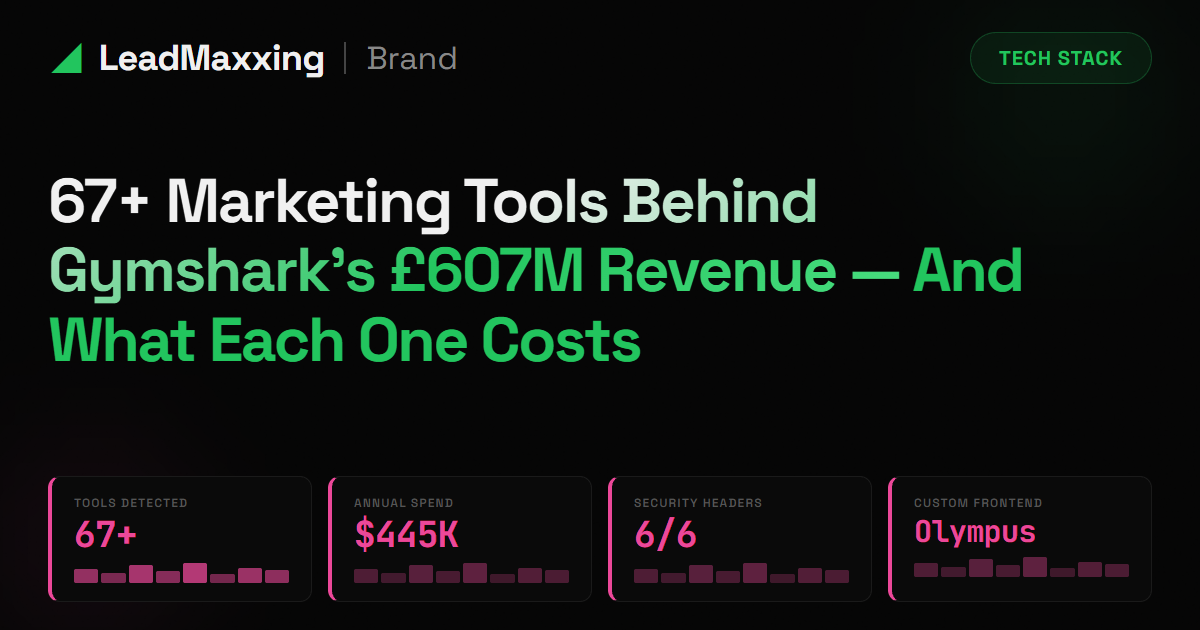
Gymshark spends an estimated $445K+/year on their marketing tech stack to track ad performance across 6 platforms. LeadMaxxing gives you cross-platform attribution, autonomous A/B testing, and AI-powered campaign optimization — starting at $29/month.
Try autonomous A/B testing →5 Things You Can Implement Today
Actionable lessons from Gymshark's ad strategy playbook
You don't need Gymshark's budget to apply their playbook. Here are the principles that work at any spend level:

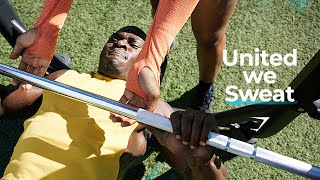
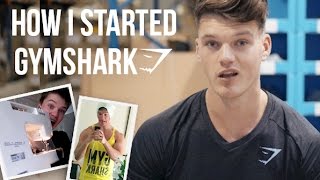
Campaign thumbnails: "We Do Gym," United We Sweat, brand films, and founder-led content — all running as paid ads.
Measure true revenue, not platform metrics
Gymshark's biggest unlock was measuring cross-channel revenue impact independently of platform-reported ROAS, revealing Pinterest was massively undervalued. LeadMaxxing tracks every click and conversion across platforms so you know where to put your next dollar — the same cross-platform attribution, automated.
Test at volume with autonomous A/B testing
Gymshark launches 135 ads in a day and kills losers in 48 hours. You don't need that creative team. LeadMaxxing generates landing page variants from your existing pages and auto-applies winners at 95% statistical significance — the same test-and-scale philosophy, automated for $29/month.
Don't ignore "small" platforms
Pinterest delivered 227% revenue growth with 41% lower CAC. Snapchat beat every channel for a product launch. LeadMaxxing's competitive reports show you exactly which platforms your competitors are investing in — so you can find your own underpriced channel before they do.
Use a data hub, not siloed pixels
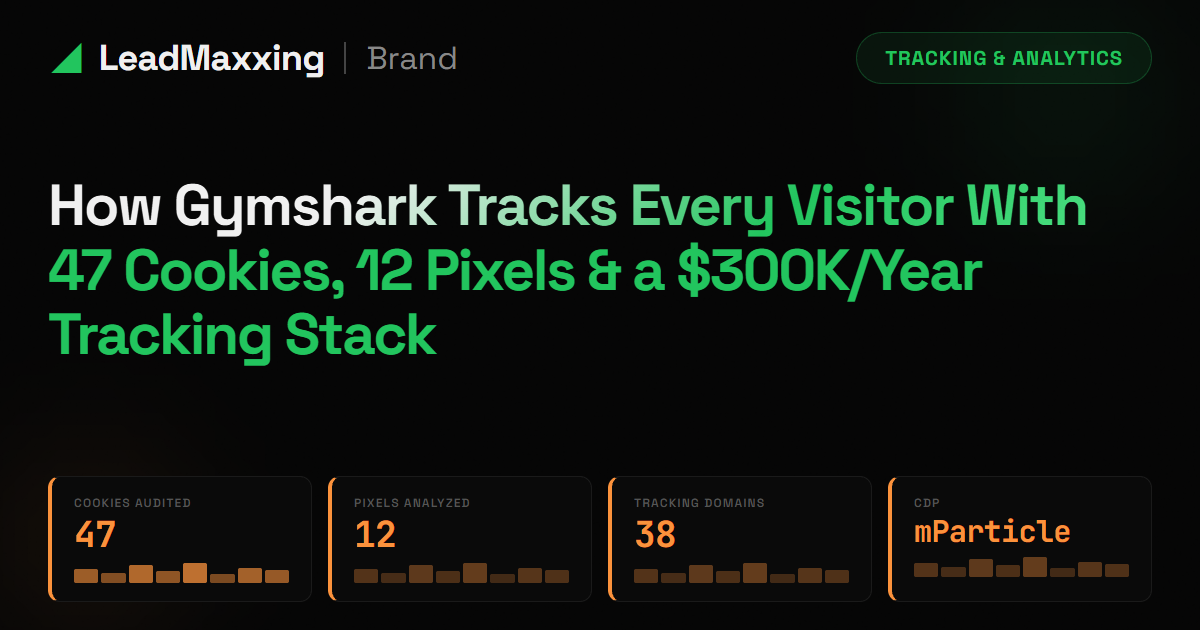
Gymshark routes all data through mParticle ($100K/yr) for unified attribution. LeadMaxxing gives you unified visitor tracking, lead scoring, and cross-platform attribution for $29/month — no enterprise CDP required. One script replaces a $300K stack.
Supercharge Your Leads with LeadMaxxing
Get a free LeadMaxxing account and start supercharging your leads. Start free →
Gymshark spends an estimated $445K+/year on their marketing tech stack (see our Tech Stack report). But the same multi-platform ad tracking, attribution, and optimization is available for a fraction of the cost. LeadMaxxing tracks ad performance across all major platforms, attributes every click and conversion, and uses AI to optimize campaigns — starting at $29/month for the same kind of cross-platform intelligence that Gymshark pays enterprise prices for.
Request a FREE Demo + Report
For Your Brand
Request a demo and we'll generate a full competitive analysis for YOUR brand. The same intelligence you just read — comparison with competitors, actionable strategies, and AI-powered recommendations.
More Gymshark Intelligence
Ad Strategy for Similar Brands



Frequently Asked Questions
How much does Gymshark spend on advertising?
Does Gymshark advertise on TikTok?
What does Gymshark's Meta ad strategy look like?
How many active ads does Gymshark run at once?
What type of ad creative works best for Gymshark?
Does Gymshark use influencer ads or brand ads?
What landing pages does Gymshark send ad traffic to?
How does Gymshark's ad spend compare to Alo Yoga and Fabletics?
Sources & References
fospha.com/case-studies/gymshark-smartly • smartly.io
facebook.com/ads/library → Gymshark
foreplay.co/post/gymsharks-700m-ad-playbook
thedigitalchapter.com
chatdesk.com
fashionunited.com
adstransparency.google.com → Gymshark
library.tiktok.com → Gymshark
gymshark.com/blog/article/gymshark-event-muscle-beach
Run
curl -sI gymshark.com | grep -i content-security to verify