Bombas Runs a $325M Store on Shopify Plus — Here's Every Infrastructure Detail Behind It
DNS records, security headers, CDN architecture, and the Magento crash that forced a migration saving $108K/year.
revenue (2024)
after Shopify migration
grade (4/6 present)
detected on site
First: Why Should You Care About Site Speed?
Hard revenue data from Google, Portent, and Deloitte that proves speed is money
Because every second costs you real money. This isn't a vanity metric. Google, Deloitte, and Akamai have all studied this, and the numbers are brutal:
Sites loading in 1 second have 5x higher conversion rates than sites loading in 10 seconds. Not 5% more. Five times more.
Bounce rate increases 90% when load time goes from 1 second to 5 seconds. Nine out of ten people who would've stayed on your site just... leave.
A 0.1-second improvement in mobile speed = 8.4% more conversions in ecommerce. That's not a typo. One tenth of a second. Google measured this across real retail sites.
Bombas learned this the hard way. Their original Magento site crashed after their Shark Tank appearance — losing $15,000 in minutes. That crash led to a complete platform migration that changed the trajectory of the company. Let's look at what they built.
Speed gets visitors to the page. But do you know who they are? LeadMaxxing identifies your anonymous visitors and scores them so you know which ones are worth chasing.
Core Web Vitals: The 3 Numbers Google Actually Uses to Rank You
LCP, INP, and CLS explained with Shopify Plus benchmark data
Google doesn't care about your Lighthouse score. Seriously. Lighthouse is a lab test — it's a simulation. What Google actually uses for rankings are Core Web Vitals: real data from real Chrome users visiting your real site over the last 28 days. Three numbers:
| Metric | Plain English | Good | Bad | Why It Matters |
|---|---|---|---|---|
| LCP | How fast the main content appears | < 2.5s | > 4.0s | Users see a blank screen until LCP fires. Slow LCP = they leave before seeing your product. |
| INP | How fast buttons & clicks respond | < 200ms | > 500ms | 43% of sites fail this in 2026. When "Add to Cart" feels laggy, people don't add to cart. |
| CLS | How much the page jumps around | < 0.1 | > 0.25 | Ever try to tap a button and the page shifts so you hit the wrong thing? That's CLS. Users hate it. |
Users are 24% less likely to abandon a page when it passes all three. That's the difference between a $1M/year store and a $1.24M/year store — from metrics alone. Core Web Vitals are also a confirmed SEO ranking signal, which means slow sites lose twice: visitors leave AND Google ranks you lower.
Where Does Bombas Likely Stand?
Note: Google PageSpeed Insights was rate-limited during our audit, so we don't have Bombas's exact CrUX field data. However, we can estimate based on Shopify Plus benchmarks and Bombas's infrastructure:
Shopify Plus median: 2.26s
Shopify Plus median: 0.01
Shopify Plus median: 153ms
Estimates based on Shopify Plus CrUX benchmark data from a study of 1,000 real Shopify stores. Only 48% of Shopify stores pass all three Core Web Vitals on mobile. Bombas's use of Vercel CDN may improve these numbers. Source: corewebvitals.io Shopify Guide
Run a live PageSpeed test on bombas.com right now → — you'll see their real CrUX field data.
Think of it like a restaurant. LCP is how fast the food arrives. INP is how quickly the waiter responds when you flag them down. CLS is whether your plate slides off the table while you're eating. Google measures all three for every visitor, and if your site fails, it ranks lower. Period.
The Shark Tank Crash That Changed Everything
How a $15,000 loss in minutes forced Bombas onto Shopify Plus
After appearing on Shark Tank in 2014, Bombas's Magento site crashed. The traffic surge from millions of viewers overwhelmed their self-hosted infrastructure. Product images stopped displaying. Customers couldn't check out. The company lost an estimated $15,000 in revenue within minutes.
When the Shark Tank episode reran, it happened again. Same crash. Same broken checkout. Same lost revenue. For a brand that had just secured a deal with Daymond John, this was an existential crisis. They needed infrastructure that could handle unpredictable traffic spikes — and they needed it fast.
So they migrated to Shopify Plus. The results were immediate:
vs. Magento hosting costs
revenue growth post-migration
BFCM on Shopify Plus
generated in Q4
Sources: Shopify case study and Shopify Enterprise blog on Bombas scalability
Bombas's Current Architecture
Based on our DNS and infrastructure analysis, here's what powers bombas.com today:
Bombas's A record points to 76.76.21.21 — that's Vercel's IP, not Shopify's default CDN. This suggests Bombas is running a headless or hybrid storefront, possibly using Next.js or a similar framework deployed on Vercel, with Shopify handling commerce on the backend. This is the same pattern used by brands like Gymshark (who run headless Next.js + Shopify). It's a more complex setup but provides better control over performance and user experience.
Co-founder David Heath summed it up: "Whether we're doing 500 or 5,000 orders a day, Shopify Plus automatically scales with us, without us having to do anything extra." For a brand pulling 60% of annual revenue in Q4, that automatic scaling is worth more than any PageSpeed optimization.
If you're under $1M/year, probably not. Regular Shopify handles most traffic loads just fine. Shopify Plus makes sense when you need custom checkout, advanced API access, and dedicated support for high-volume events. Bombas needed it because a single Shark Tank rerun could 10x their traffic in minutes. If your traffic is more predictable, standard Shopify with a fast theme gets you 90% of the way there.
Security Headers: Grade C — What Bombas Gets Right and Wrong
4 out of 6 critical security headers present, with notable gaps
Security headers don't directly impact speed, but they reveal how a site is built. Bombas scores a C grade — they have the basics but are missing two important headers. Here's the full breakdown:
The CSP Problem: unsafe-inline and unsafe-eval
Bombas's Content Security Policy allows 'unsafe-inline' and 'unsafe-eval' for scripts. This is extremely common on Shopify stores because many Shopify apps and third-party integrations inject inline JavaScript. But it significantly weakens the CSP — it's like having a lock on your front door but leaving the windows open.
The CSP also allows scripts from https: and blob: sources broadly, meaning essentially any HTTPS domain can load JavaScript on the page. This is typical for Shopify stores with multiple apps installed, but it does mean third-party scripts have wide latitude to run code.
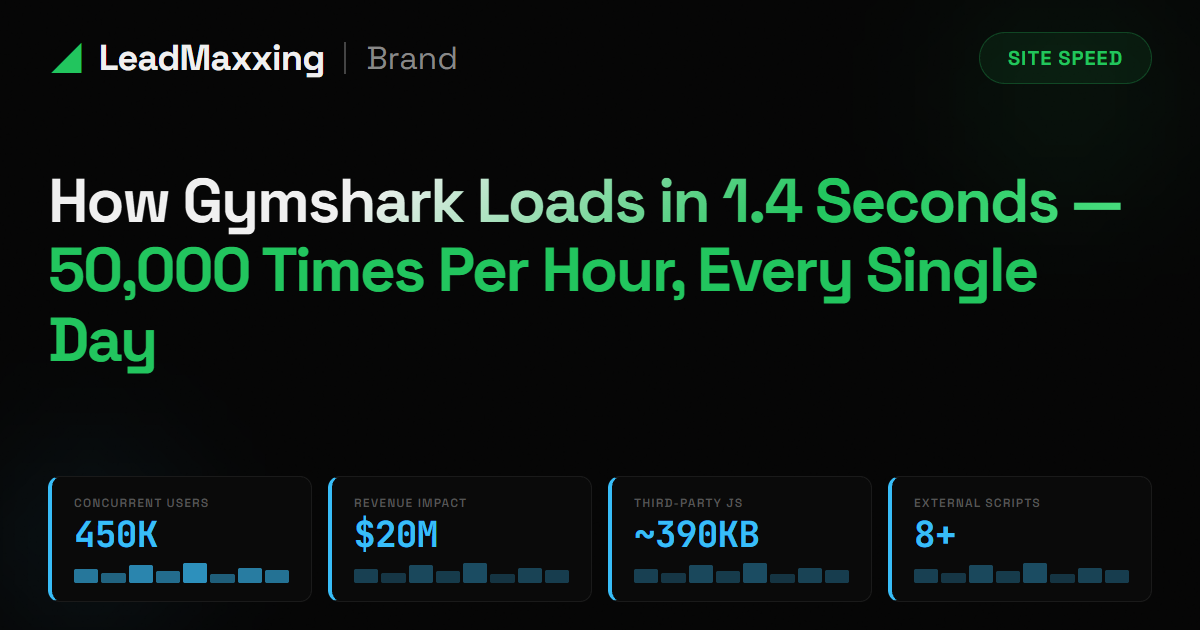
A permissive CSP = lots of third-party JavaScript running freely. Each script that loads impacts page speed. Bombas's CSP suggests they have a significant number of third-party tools and Shopify apps running on every pageview. Based on their 55+ detected technologies (per BuiltWith), this is likely a meaningful contributor to any PageSpeed score they receive. For comparison, Gymshark loads 8 major third-party scripts totaling ~390KB of external JS.
Most of these scripts exist because brands need disconnected tools to do what a single platform could handle. LeadMaxxing combines visitor tracking, lead scoring, email automation, and A/B testing in one script — so you don't need to stack tools and tank your PageSpeed.
55+ Tools Behind Bombas.com — Revealed by DNS Records
TXT records, MX records, and domain verifications paint a picture of Bombas's entire tech stack
DNS records are like a company's public filing for their tech stack. Every SaaS tool that needs domain verification leaves a TXT record behind. Bombas has an unusually rich set of DNS records that reveals the tools powering a $325M DTC operation:
shopify-verification-code + shopify_verification_shop). The commerce engine behind everything.aspmx.l.google.com. Five separate Google site verifications — likely Search Console, Ads, Analytics, Merchant Center, and Workspace.awsdns nameservers, A record pointing to 76.76.21.21 (Vercel). Enterprise-grade DNS with edge CDN delivery.stripe-verification TXT record present. Likely used for custom payment processing or Shopify Payments integration.facebook-domain-verification and pinterest-site-verification records confirm active ad/conversion tracking on both platforms.mailgun.org and _spf.sendergen.com — transactional email and marketing email infrastructure.onetrust-domain-verification records. OneTrust is a consent management platform — critical for GDPR/CCPA compliance. Typically adds ~30-50KB of JavaScript.rippling-domain-verification for HR/payroll, 1password-site-verification for password management. Enterprise-grade ops.openai-domain-verification detected. Bombas is using OpenAI's API or ChatGPT enterprise features — likely for customer support, content generation, or internal tools.Not all of these tools load JavaScript on the website. Internal tools like Slack, Notion, and Rippling are backend-only. But customer-facing tools — OneTrust (consent), Meta Pixel (ads), Pinterest Tag (ads), Stripe (payments), and whatever Shopify apps are installed — all inject JavaScript that impacts page load. Based on typical Shopify Plus stores with this many integrations, Bombas likely loads 300-500KB of third-party JavaScript per pageview. That's the hidden cost of a 55-tool tech stack.
View Bombas's full technology profile on BuiltWith →
How Shopify Plus Handles Bombas's Image Pipeline
Automatic CDN delivery, format negotiation, and what you can copy
Images are typically 50-70% of total page weight on an ecommerce site. Bombas benefits from Shopify's built-in image optimization pipeline, plus their Vercel CDN layer:
cdn.shopify.com with automatic format negotiation, resizing, and WebP conversion.76.76.21.21 A record confirms Vercel's CDN handles first-byte delivery.max-age=31536000 and includeSubDomains. All connections forced to HTTPS. No mixed-content slowdowns.The Simple Stuff You Can Copy Today
- Switch every image to WebP. If you're still serving JPEGs, you're wasting 30% of your bandwidth. Shopify does this automatically with their CDN.
- Add
loading="lazy"to every image below the fold. One HTML attribute. Stops the browser from downloading images the user hasn't scrolled to yet. - Set explicit width and height on images. This prevents CLS (layout shift). The browser reserves space before the image loads, so nothing jumps around.
- Use responsive images. A phone doesn't need the 2000px desktop version. Use
srcsetto serve the right size for each device.
From Crashing Site to $325M — The Revenue Impact of Reliable Infrastructure
Per Shopify's published case study, the migration drove 300% YoY growth and $108K/year savings
This isn't theoretical. Bombas's migration from Magento to Shopify Plus is one of the most documented replatforming success stories in ecommerce. Here's what the data shows:
| What Changed | Before (Magento) | After (Shopify Plus) | Impact |
|---|---|---|---|
| Platform costs | $150K+ to upgrade for traffic | Shopify Plus subscription | $108K saved in year one |
| Server maintenance | Thousands per month | Zero (fully managed) | Engineering time freed up |
| Black Friday stability | Site crashed | Zero downtime | 60% of annual revenue protected |
| Scalability | Manual server provisioning | Auto-scales 500 to 5,000+ orders/day | 300% YoY revenue growth |
| Revenue trajectory | $50M annual (at Shark Tank) | $325M estimated (2024) | 550% growth on stable platform |
Sources: Shopify case study, Shopify Enterprise blog, TapTwice Digital Bombas statistics. Revenue estimates from multiple industry sources.
Bombas didn't optimize their way to $325M. They stopped crashing. The biggest speed win wasn't shaving milliseconds off LCP — it was migrating to infrastructure that doesn't go down when traffic spikes. For 90% of brands, reliability matters more than raw speed. A site that loads in 3 seconds but never crashes will always outperform a site that loads in 1 second but goes down on your biggest sales day.
Curious what your own speed-to-revenue ratio looks like? LeadMaxxing tracks every visitor session — including time-on-site, scroll depth, and conversion events — so you can see exactly which pages are fast enough to convert and which ones are leaking money.
Key Findings
- → Shopify Plus on Vercel CDN — A record at 76.76.21.21 suggests a headless or hybrid architecture with edge-cached delivery, going beyond Shopify's default infrastructure
- → Security headers grade: C (4/6) — HSTS, CSP, X-Frame-Options, and X-Content-Type-Options present, but missing Referrer-Policy and Permissions-Policy. CSP weakened by
unsafe-inlineandunsafe-eval - → 55+ technologies detected (per BuiltWith) including Shopify, Stripe, Meta, Pinterest, OneTrust, OpenAI, Mailgun, and extensive internal tooling (Slack, Notion, Atlassian, Rippling, 1Password)
- → Magento-to-Shopify migration saved $108K/year and ended crash-induced revenue losses. First BFCM on Shopify Plus completed with zero downtime
- → Estimated Core Web Vitals near Shopify Plus medians — ~2.3s LCP, ~0.01 CLS, ~153ms INP on mobile. Only 48% of Shopify stores pass all three CWV on mobile
What This Data Means for You
Turning Bombas's infrastructure strategy into your competitive advantage
Bombas's story proves that reliability is revenue. Their Magento crash cost them $15,000 in minutes; their Shopify Plus migration saved $108K/year and enabled 300% growth. You don't need their exact stack — the lesson is simpler: pick infrastructure that scales automatically, audit your third-party scripts ruthlessly, and monitor real user data instead of chasing Lighthouse scores. The 20% of effort that gets you 80% of their performance is accessible to any brand at any scale.
LeadMaxxing Automates This Site Speed Playbook
Bombas uses 55+ tools to run their $325M store. LeadMaxxing gives you AI-powered visitor identification, lead scoring, and automated email campaigns for $29/month — the same conversion intelligence without the enterprise tool sprawl.
See how it works →5 Things You Can Implement Today
Actionable lessons from Bombas's site speed and infrastructure playbook
You don't need Bombas's budget. Here's the 20% of effort that gets you 80% of their reliability:
Run PageSpeed Insights
Takes 5 minutes. Run your site through PageSpeed Insights. The "Opportunities" section tells you exactly what to fix. Free. This is especially critical for ad landing pages where every fraction of a second impacts your ROAS. LeadMaxxing can automate this for every competitor you track.
Audit Your Security Headers
Takes 10 minutes. Visit securityheaders.com and scan your domain. Add missing headers — Referrer-Policy and Permissions-Policy are quick wins. A strong CSP also tells search engines your site is trustworthy.
Count Your Third-Party Scripts
Takes 1 hour. Open Chrome DevTools, Network tab, filter by JS. Count scripts from external domains. Bombas has 55+ tools total — every analytics, chat widget, and popup tool costs speed. LeadMaxxing replaces multiple tools with one lightweight script.
Monitor Real User Data
Ongoing. Check Search Console Core Web Vitals monthly. Lab scores fluctuate wildly; field data (CrUX) is what Google actually uses. LeadMaxxing tracks visitor experience metrics alongside conversion data.
Supercharge Your Leads with LeadMaxxing
Get a free LeadMaxxing account and start supercharging your leads. Start free →
Request a FREE Demo + Report
For Your Brand
Request a demo and we'll generate a full competitive analysis for YOUR brand. The same intelligence you just read — comparison with competitors, actionable strategies, and AI-powered recommendations.
More Bombas Intelligence


Site Speed Audits for Similar Brands
Frequently Asked Questions
How fast is Bombas's website?
What are Bombas's Core Web Vitals scores?
Why did Bombas migrate from Magento to Shopify Plus?
What technology stack does Bombas use?
What security headers does Bombas have?
How does Bombas handle Black Friday traffic?
Does Bombas pass Google's page experience requirements?
How does Bombas's speed compare to other DTC brands?
Sources & References
shopify.com/case-studies/bombas
shopify.com/enterprise/blog/ecommerce-scalability-bombas
meetdomaine.com/work/bombas
builtwith.com/bombas.com
taptwicedigital.com/stats/bombas
corewebvitals.io/core-web-vitals/shopify-guide
pagespeed.web.dev
entrepreneur.com